Kinh Thien Palace restoration project kicked off
VGP - Commencement ceremony for the project on the preservation, restoration, and reconstruction of Kinh Thien Palace, Central Sector of the Imperial Citadel of Thang Long took place on September 29.
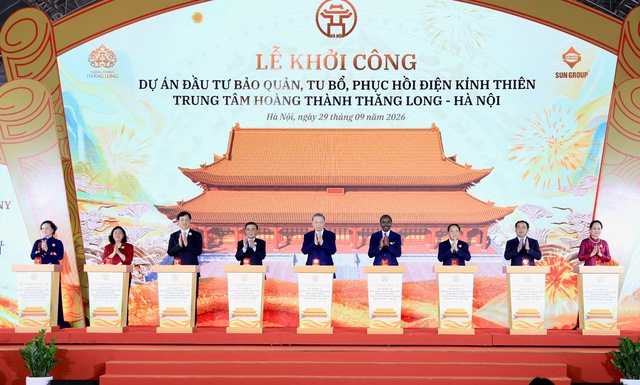
General Secretary and President To Lam (C) attends the commencement ceremony for the project on the preservation, restoration, and reconstruction of Kinh Thien Palace, Central Sector of the Imperial Citadel of Thang Long, September 29, 2026 - Photo: VGP
The event was attended by General Secretary and President To Lam, together with leaders of the Party and State, representatives of central-level agencies and the Ha Noi authorities; Director of the UNESCO World Heritage Centre Lazare Eloundou Assomo; United Nations Resident Coordinator in Viet Nam Pauline Tamesis; UNESCO Representative to Viet Nam Jonathan Wallace Baker; as well as international and Vietnamese experts in culture and heritage, and community representatives.
Addressing the ceremony, Chairman of the Ha Noi People's Committee Vu Dai Thang said the Thang Long Imperial Citadel was inscribed on the UNESCO World Heritage List in 2010. It embodies the outstanding universal value of a site that served as the centre of national power continuously for more than 13 centuries, as evidenced by its overlapping cultural strata and surviving architectural traces.
Within this space, Kinh Thien was the principal palace of the Forbidden City of Thang Long under the Le Dynasty (1428 -1789). According to the Dai Viet Su Ky Toan Thu (The Complete Annals of Dai Viet), construction began in 1428 under King Le Thai To and was completed under King Le Thanh Tong (1442–1497), on the foundations of principal palaces dating back to the Ly and Tran dynasties.
It was the center of political power and royal ceremonies, where the court held audiences, conducted major ceremonies and received envoys. It was also the highest symbol of the national power of Dai Viet from the 15th to the 18th centuries.
The conservation, restoration and rehabilitation of Kinh Thien Palace must be carried out on a scientific basis, with maximum respect for original elements, archaeological and historical evidence, and interdisciplinary research findings, while preserving the archaeological remains already unearthed.
The Ha Noi People's Committee Chairman stressed that the capital city views heritage conservation as an integral part of its development strategy.
Speaking at the ceremony, Lazare said, this day marks an important step in a long but essential process of scientific research, documentation, consultation and dialogue for the reconstruction of the Kinh Thien Palace and its surrounding area.
Since 2023, the World Heritage Centre and the UNESCO Office in Ha Noi have supported this process from its early stages, together with ICOMOS, an Advisory Body to the World Heritage Committee, and Vietnamese partners.
Today's ceremony marks the beginning of a new phase in efforts to understand, protect and transmit the heritage of Thang Long to future generations. UNESCO also commended the dedication and collaboration of the people and institutions involved in this process. This reflects the exceptional value of the World Heritage property, the Central Sector of the Imperial Citadel of Thang Long - Ha Noi.
Last year, at the 48th session of the UNESCO Heritage Committee in Busan, Republic of Korea, the committee approved Viet Nam's proposal to restore the Celestial Palace within the Thang Long Citadel grounds.
Prior to the decision, UNESCO allowed Viet Nam to dismantle the citadel's buildings that were constructed during French colonial rule with full documentation, so that they can be rebuilt elsewhere.
The Thang Long Citadel was recognized by UNESCO as a world heritage site in 2010, when the city celebrated its 1,000th anniversary since King Ly Cong Uan made Thang Long the capital of the Dai Viet Kingdom./.