Ha Noi shares experience in two-tier local government model with Laos
VGP - A delegation from the Central Committee of the Lao People's Revolutionary Party (LPRP) on July 31 visited Ha Noi to study the city's implementation of the two-tier local government model and administrative reform experience.
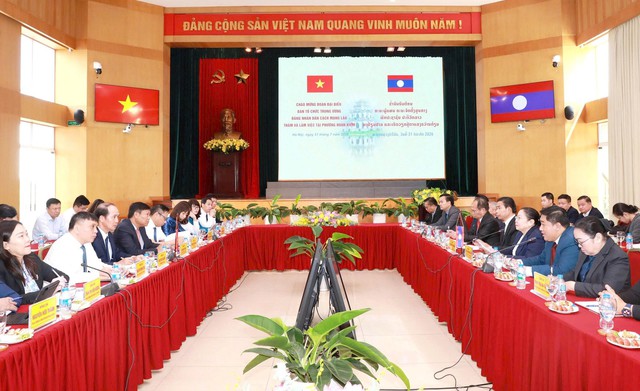
Sisay Leudetmounsone, Politburo member, Secretary of the Central Committee of the Lao People's Revolutionary Party (LPRP) and head of its Organization Commission works with Ha Noi's authorities, Ha Noi, July 31, 2026 - Photo: Hanoimoi
The Lao delegation was led by Sisay Leudetmounsone, Politburo member, Secretary of the Central Committee of the Lao People's Revolutionary Party (LPRP) and head of its Organization Commission.
Vice Chairman of Ha Noi's People's Committee Do Anh Tuan reaffirmed that Ha Noi highly values the special Viet Nam–Laos relationship and wishes to further strengthen exchanges and cooperation with Lao agencies and localities based on sincerity, trust, equality, mutual support, and shared development.
According to Do, after more than one year of implementation, Ha Noi's two-tier local government system has largely been consolidated and is operating smoothly.
Its core objective is to build a streamlined, effective, and efficient administration that remains close to the people, resolves issues more quickly with clearer accountability, and delivers better services to citizens and businesses.
During the meeting, representatives of Ha Noi presented the city's achievements and experience in implementing the two-tier local government model. To date, the implementation has been carried out comprehensively across all four pillars of the political system.
Under the new model, commune- and ward-level authorities have been granted greater powers, gradually becoming the primary governance centers for their localities.
Public services are now delivered closer to residents, with greater convenience and fewer administrative layers.
At the same time, city governance has shifted decisively toward a digital environment, with administration increasingly driven by data.
Administrative discipline, accountability, and the responsibility of agency heads have also been further strengthened.
Leudetmounsone, for his part, noted that Laos has also been accelerating institutional restructuring by streamlining its organizational apparatus and adjusting the functions, responsibilities, and authority of ministries, agencies, and local governments.
He added that Laos's reform process also seeks to clearly define the powers and responsibilities of local governments, promote decentralization and delegation of authority, and ensure that personnel are assigned in line with practical requirements.
On that basis, Leudetmounsone expressed his hope that the two sides would continue strengthening exchanges of experience and mutual support in local governance, administrative reform, and institutional organization, thereby enhancing the effectiveness of state governance and improving people's quality of life.
The two sides also shared challenges and practical experience in local governance, civil service development, administrative reform, digital transformation, and public service delivery, contributing to further deepening the special friendship, solidarity, and comprehensive cooperation between the two Parties, the two States, and the peoples of Viet Nam and Laos./.