Ha Noi to issue air pollution warnings up to seven days ahead
VGP - Ha Noi will issue early warnings of potential air pollution five to seven days in advance, giving authorities, businesses and residents time to take preventive measures before air quality deteriorates.
Illustration photo
The Ha Noi People's Committee introduced a plan to strengthen air pollution control and improve the capital's capacity to respond to deteriorating air quality, with a focus on major emission sources and early intervention.
The plan targets dust from construction sites and the transport of building materials, road dust, the burning of rice straw and agricultural by-products, and the open burning of rubbish and other waste. Emissions from traffic, industrial activities and other sources will also be subject to tighter controls.
Under the plan, the city will use air quality monitoring data, meteorological forecasts and pollution prediction models to issue early warnings and activate preventive measures. Forecasts will be updated regularly based on short-term projections and actual monitoring results.
The Ha Noi Department of Agriculture and Environment will coordinate with meteorological and hydrological agencies and specialized units under the Ministry of Agriculture and Environment to receive and operate forecasting systems for the capital.
Five to seven days before a potential pollution event, the department will issue preliminary assessments to agencies and organizations across the city, disseminate warnings through mass media and initiate reviews of major emission sources.
Between 48 and 72 hours before a forecast pollution event, authorities must update assessments of the areas likely to be affected and the expected severity. Within 24 hours, they will refine forecasts, adjust warning coverage and directly notify affected groups.
The department will lead inspections of industrial emission sources, craft villages, facilities involving combustion processes and waste treatment sites. Inspections of high-risk facilities will be intensified when pollution is forecast, with violations requiring prompt remediation.
The Department of Construction, in coordination with city police, will monitor vehicle emissions and organize traffic to ease congestion at pollution hotspots. Commune- and ward-level authorities will tighten controls on the burning of fuels and waste in residential areas and craft villages.
Meanwhile, the Department of Science and Technology will lead research and propose technological solutions to reduce emissions and improve air quality across the capital.
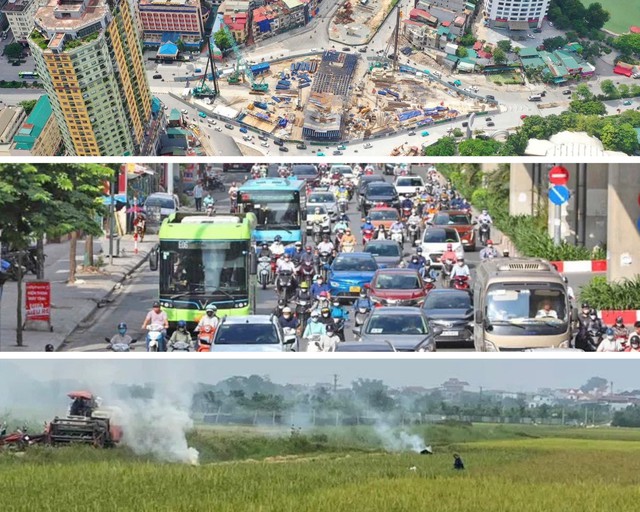
Ha Noi's air polution comes from three major sources including road dust generated by traffic, dust from construction and the transportation of building materials, and smoke and ash from the burning of agricultural by-products
Ha Noi steps up control of three major emission sources
Air pollution during the autumn and dry seasons remains a major concern for the capital.
Monitoring data for the first nine months of this year showed a marked improvement in air quality compared with the same period last year. From January 1 to September 29, days with good or moderate air quality accounted for 74.42 percent of the total, approaching the city's annual target of more than 75 percent.
Deputy Director of the Ha Noi Department of Agriculture and Environment Nguyen Minh Tan identified three major sources of pollution: road dust generated by traffic, dust from construction and the transportation of building materials, and smoke and ash from the burning of agricultural by-products.
He noted that vehicles can resuspend dust from road surfaces, particularly in areas with heavy traffic. Construction, demolition and the transport of materials also contribute to airborne dust when adequate containment measures are not in place, while open burning during the harvest season adds smoke and ash to the atmosphere.
To address pollution from open burning, the city is strengthening community and business engagement, stepping up inspections and imposing penalties for violations. It has also introduced monitoring systems to detect open burning and intensified inspections at the local level.
For construction-related dust, investors, contractors and management agencies are required to strengthen supervision, install protective coverings, spray water and wash vehicles before they enter or leave construction sites to minimize dust dispersion.
All 126 communes and wards have also been instructed to intensify street cleaning, watering and road washing to reduce airborne particulate matter.
Ha Noi is pursuing complementary measures to reduce transport-related emissions. Since July 1, Hoan Kiem Ward has piloted a low-emission zone as part of the capital's efforts to improve urban air quality and promote cleaner mobility. The initiative complements the city's transition toward greener transport, including vehicle emissions testing launched in March this year.
The capital currently has more than 2,300 electric vehicle charging locations, with 10,209 charging ports and approximately 1,650 battery-swapping cabinets.
Its public bus network comprises 156 routes operated by 1,977 vehicles. Of these, 875 vehicles have been converted to cleaner energy, accounting for 44.3 percent of the fleet and exceeding the target set for this year.
Through early-warning systems, stricter emission controls, improved construction-site management and the expansion of cleaner transport, Ha Noi aims to strengthen its response to seasonal pollution and improve air quality for residents./.