Ha Noi takes action as air pollution reaches alarming levels
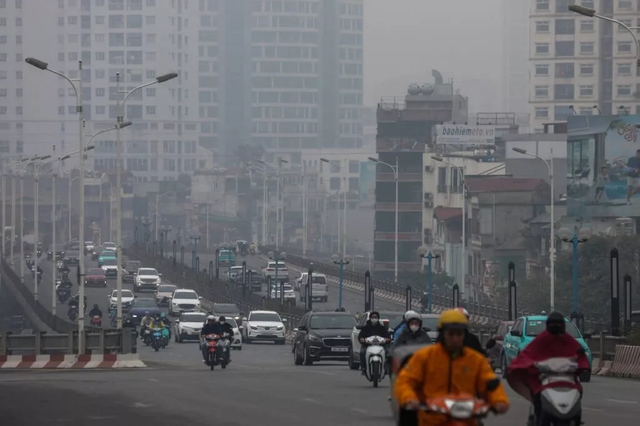
VGP - Ha Noi has rolled out a series of urgent measures to curb worsening air pollution, after several days of hazardous air quality that placed the capital among the most polluted cities in the world.
In recent years, Ha Noi has implemented a variety of measures to reduce pollution. These include requiring construction sites to control dust and manage waste; phasing out honeycomb coal stoves; banning straw and agricultural waste burning; and piloting low-emission zones that encourage the use of electric cars and motorbikes while restricting petrol and diesel vehicles.
Most recently, the Ha Noi Party Committee issued a program to implement the Resolution of the 18th Congress of the Municipal Party Organiztion for the 2025–2030 tenure, reaffirming its commitment to tackling air and water pollution once and for all.
The Ha Noi People's Committee has directed city departments and local authorities to step up enforcement of urgent air-quality measures. A roadmap has been drafted to relocate industrial production facilities out of inner districts. The Department of Construction has been tasked with strictly supervising contractors to ensure that 100 percent of construction sites install dust coverings, operate vehicle-washing systems, and use mist-spraying equipment to limit dust.
Projects covering more than 10,000 square meters are now required to install automatic dust-monitoring systems and provide additional barriers to prevent pollution from spreading into surrounding areas.
Meanwhile, the Traffic Police and Environmental Police have intensified inspections and penalties for vehicles overdue for inspection, emitting black smoke, or transporting materials without proper covering—causing spillage and road debris. Local authorities have increased the frequency of street sweeping, vacuuming, and road washing, and strengthened monitoring and enforcement against illegal burning of household waste, straw, and agricultural residues. Technology is also being deployed to detect and strictly penalize unauthorized burning activities.
Despite these efforts, Ha Noi's pollution levels remain high and the city has not yet achieved its targeted reductions. Acknowledging existing shortcomings will be critical to future progress.
Weak enforcement remains a key concern. Many construction sites and trucks carrying construction materials merely apply superficial dust-control measures without consequences. At the same time, enforcement against vehicles emitting pollutants beyond permissible limits remains inadequate.
Experts say Ha Noi must prioritize rigorous scientific research on emission sources to build a stronger foundation for long-term solutions. Accurate data will help identify priority pollutants and guide targeted interventions.
Ha Noi's environmental challenges are not new. For years, the capital grappled with heavily polluted rivers. However, the revitalization of the To Lich River has shown that when authorities take systematic, science-based approaches and mobilize sufficient resources, environmental recovery is possible. The To Lich success story, which has significantly improved water quality and met public expectations, offers a valuable model for addressing air pollution.
As Ha Noi confronts one of its most pressing public-health challenges, experts argue that only a combination of robust scientific research, consistent enforcement, and comprehensive policy implementation will yield lasting improvements. The capital's recent pollution spike underscores the urgency of coordinated action—both from authorities and the wider community—to secure cleaner air for its more than 8 million residents.
On the evening of December 7, data from multiple environmental monitoring platforms showed Hà Nội's average Air Quality Index (AQI) reaching 230—classified as "very unhealthy"—making it the world's most polluted city at that time. Several monitoring stations in the capital posted even more concerning levels: Quang Khanh recorded an AQI of 295, Hai Ba Trung 250, and Ha Bang Commune 222. Inner-city districts such as Thanh Xuan, Tay Ho, and Vinh Tuy also reported readings harmful to public health.
The capital has repeatedly appeared among the top ten most polluted cities globally in recent years. Key contributors to the poor air quality include emissions from millions of fossil fuel–powered vehicles, dust from construction and urban renovation, and the burning of straw and votive paper. Seasonal weather patterns exacerbate the problem: winter's low rainfall and stagnant air prevent the dispersion of pollutants, trapping them close to the ground for prolonged periods./.